The written version
Solar panels and a battery: follow the sunshine
These labs are a visualisation aid to help you picture how a house works. They are not technical advice: the models and figures are simplified, so please don't rely on them for design, specification or buying decisions. Ask a qualified designer, engineer or installer about your own home.
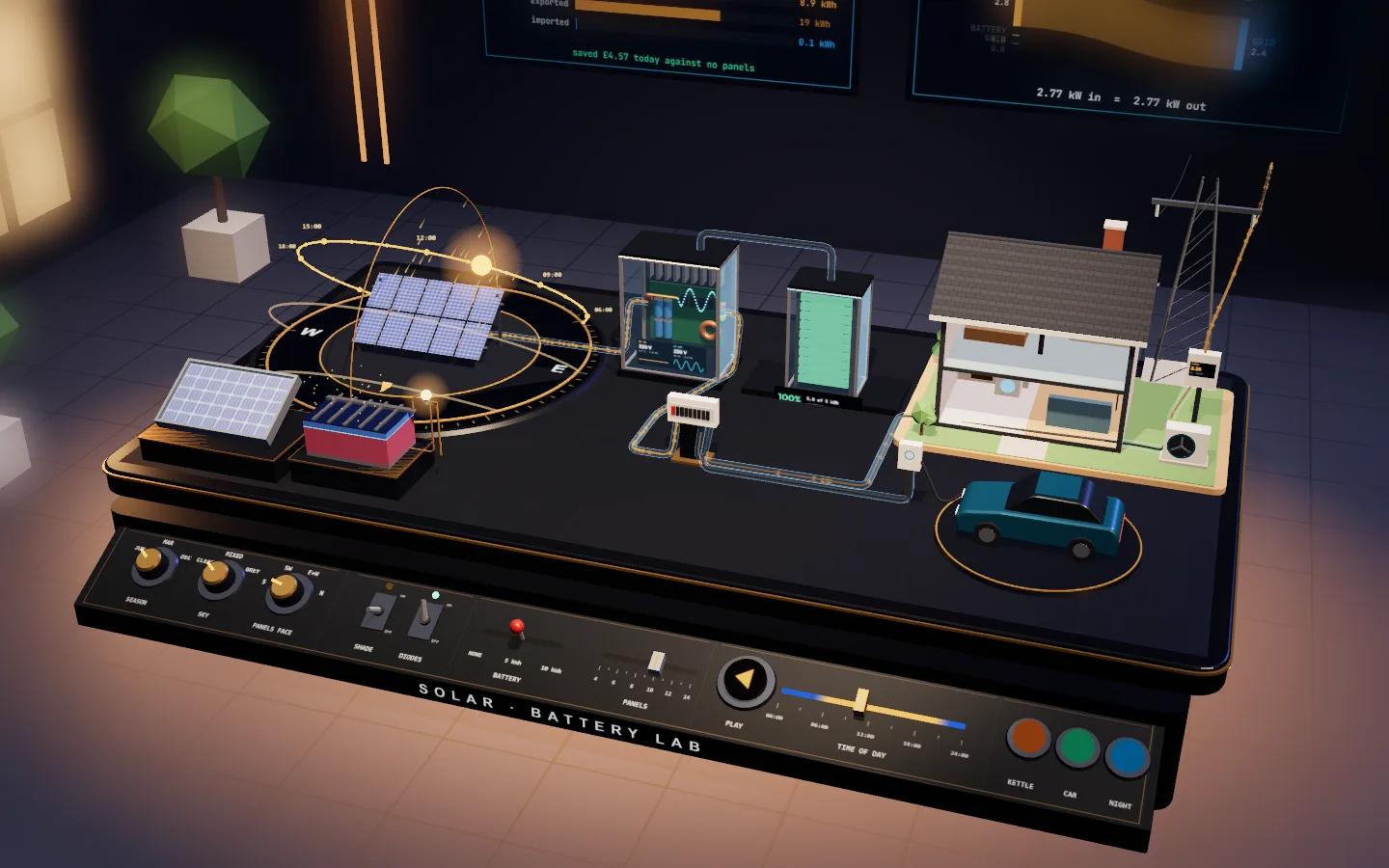
Light frees electrons in a solar panel, an inverter turns them into mains power, and the house, the battery and the grid share it out second by second. This lab runs one day in a new, all-electric house near Birmingham, minute by minute, as six experiments. Each asks a question and answers it from the same model.
How solar panels and a battery work, step by step
Sunlight on a slope
Why do panels make the most around midday?
A panel is rated in test-lab sun of 1,000 W/m² falling straight onto it, and on a roof the sun is rarely straight on. At 10:20 on 21 June the sun is 47° above the horizon and its light meets a south-facing roof at 35° about 40° away from straight on. A slanting beam spreads across more glass, so each square metre catches 77% of the direct light it would get facing the sun. With the light scattered from the rest of the sky the panels receive 753 W/m² and the 4.3 kWp array makes 2.6 kW.
As the sun climbs and swings round to the south the angle closes, and the array peaks at about 3.4 kW around 13:09, because clocks are on summer time. A low sun is weaker for a second reason: its light crosses more air on the way down. In June it rises at 04:44, 48° round from north, so for the first and last hours of the day it shines on a south roof from behind.
Inside a panel
How does light turn into electricity?
Under the toughened glass and a clear encapsulant are the cells: wafers of silicon in two layers, treated so the top has spare electrons and the bottom too few. Where the layers meet there is a built-in electric field. Light absorbed near it frees electrons, and the field sweeps them up to fine silver lines on the cell's face. They can only get back to the bottom layer by going round the outside circuit, through whatever is plugged in, and that flow is the current. About 22% of the light becomes electricity; the rest warms the panel.
A cell gives about 0.6 V. A 430 W panel wires 54 of them (pairs of half-cells) in series to reach 32 V, and ten panels in a string reach 320 V. The light sets the current: at the brightest moment of the clear June day, 999 W/m², the string carries 10.7 A, and in half the light it would carry about half as much at almost the same voltage.
Because every panel in a string carries the same current, shade matters more than its size suggests. Keep the direct sun off one panel of ten all day and, with the bypass diodes every modern panel has, the clear June day falls from 28.1 kWh to 25.3 kWh: the string loses about that one panel. Without the diodes the shaded panel would hold the whole string to its own dim current, and the day would give 3.6 kWh.
First come, first served
Where does the power go?
Electricity has to be used the instant it is made, so the inverter shares the solar out in order: first to whatever the house is using, then into the battery, and only what is left goes out to the grid. Whatever the panels can't cover, the battery or the grid tops up, so what comes in always matches what goes out.
At half past one on the clear June day the panels make 3.4 kW and the house, with the heat pump heating the hot water, uses 1.5 kW; with no battery the other 1.9 kW goes out through the meter. At 10:31 the kettle and the washing machine are on together: the house wants 3.4 kW, more than the 2.7 kW the panels make, so the battery adds 0.7 kW for those few minutes.
Keep it for tea
What does a battery actually do?
A battery has two sizes that matter. Its capacity in kWh is how much it holds, like the size of a tank. Its power in kW is how fast it can fill or empty, like the width of the tap. The 5 kWh battery here gives up to 2.6 kW and the 10 kWh one 5 kW. About 10% of what goes in is lost on the way through.
On the clear June day the 5 kWh battery soaks up the morning's spare solar and is full by about 09:40. Through the evening it covers the cooking, the TV, the lights and the fridge: at 21:00 it still holds 71%. It hands back 3.3 kWh over the day, and grid import falls from 3.4 kWh to 0.1 kWh. Boil the kettle at half past eight and the house wants 3.3 kW: the battery gives its full 2.6 kW and the grid supplies the other 0.6 kW.
Summer and winter
Why can't the panels cover a winter's day?
In late December the sun peaks at 14° and sets before four. Even on a clear day the same panels make 10 kWh, while the house uses 21.3 kWh because the heat pump is working hard. On an average December day they make 4.4 kWh, about 21% of what the house uses. Over a year, 69% of the solar comes between April and September.
A cloud crossing the sun cuts output by most of its value within a minute, but light scattered from the whole sky keeps the panels going: an average March day gives 11.2 kWh, and a grey June day 5.2 kWh against 28.1 kWh in clear sun. Direction matters too. Over a year 1 kWp on a 35° roof near Birmingham makes about 954 kWh facing south, 896 kWh facing south-west, 770 kWh split east and west and 556 kWh facing north. Pitch matters less: on a south roof a 20° pitch gives 920 kWh, 45° gives 953 kWh and panels laid flat 813 kWh.
Use it, store it or sell it
What is a kilowatt-hour of sunshine worth?
Every kilowatt-hour the house uses from its own panels is one it doesn't buy at 26p. One exported earns 12p (both example prices), so sunshine is worth about twice as much used at home. That is why it pays to run the washing machine and charge the car in the sunny hours, and why a battery helps.
Over a year the 4.3 kWp array makes about 4,100 kWh, against 5,270 kWh used by this all-electric house. With no battery the house uses 40% of its solar and exports the rest; with a 5 kWh battery it uses 73%. The year's electricity bill falls from £1,370 with no panels to about £650 with the panels alone and £480 with the battery. On a night-rate tariff (7p from 23:30 to 05:30, 28p the rest of the day) the same house with no panels would pay about £1,190; with the panels, and the battery filling overnight, about £120.
So the 5 kWh battery is worth about £170 a year to this house on a flat tariff, and about £370 on the night rate, where the panels alone would leave a bill of about £490. On the night rate it saves in two ways: it keeps sunshine for the evening, and it hands back electricity bought at 7p overnight when the price is 28p. These sums leave out the daily standing charge and what the panels and the battery cost to buy and fit.
Solar panel output by month
An average day in each month from the same model: the 4.3 kWp array on a south roof at 35° near Birmingham, and what the house uses. From April to September the panels make more each month than the house uses, though not always at the hours it needs it. From October to March they make less than the house uses, and in December only 21% of it. A sunny or dull month can be well above or below these averages.
Solar output and use by month, kWh| Month | Made on an average day | Made in the month | House uses in the month |
|---|
| January | 4.7 | 147 | 677 |
|---|
| February | 7.4 | 208 | 566 |
|---|
| March | 11.2 | 349 | 526 |
|---|
| April | 15.1 | 452 | 410 |
|---|
| May | 16.3 | 504 | 326 |
|---|
| June | 16.9 | 506 | 268 |
|---|
| July | 16.9 | 525 | 278 |
|---|
| August | 14.8 | 459 | 282 |
|---|
| September | 12.9 | 387 | 304 |
|---|
| October | 8.3 | 256 | 421 |
|---|
| November | 5.8 | 173 | 550 |
|---|
| December | 4.4 | 138 | 661 |
|---|
| Year | | about 4,100 | about 5,270 |
|---|
Parts of a solar panel and battery system
The sun, roof direction and pitch
- The sun
The lamp rides the sun's real path across the sky near Birmingham, minute by minute. At midday in late June it is 61° above the horizon; in March, 37°; in December, only 14°. A low sun's light crosses more air on the way down and arrives at a slant, so it delivers far less to the panels.
On a clear June day each square metre of a south roof at 35° receives about 8 kWh of sunlight; on a clear December day, under 3.
- The sun's path through the year
The three brass arcs are the sun's paths on 21 June, 21 March and 21 December, drawn around the panels the way you would see them from the roof. The brass ring is the horizon and the hoop running over the top joins north and south. In June the sun rises in the north-east and sets in the north-west, so it shines on a south roof from behind for the first and last hours of the day.
Daylight runs from almost 17 hours in late June to under 8 in late December.
- Solar panels
Ten 430 W panels make a 4.3 kWp array. Kilowatts peak is what they make in test-lab sun of 1,000 W/m² on a cool panel, which a British roof sees only on the brightest days. Each panel turns about 22% of the light that lands on it into electricity; the rest warms it.
An MCS installer estimates a year's output as kWp × a figure for your postcode zone, pitch and direction × a shade factor. This model, using PVGIS sunlight data, gives about 954 kWh for each kWp on a south roof.
- Which way the roof faces
The turntable stands for the roof. South is best in England; south-west and south-east lose a little; an east and west roof spreads a smaller total across the morning and evening, which suits a house that uses more then. Pitch matters less than people expect: anything from about 20° to 50° does well.
A year from 1 kWp near Birmingham (PVGIS): south 954 kWh, south-west 896, east and west 770, north 556. Laid flat, 813; on a south wall, 708.
Inside a panel
- Glass and encapsulant
The top layer is 3 to 4 mm of toughened glass with a textured, anti-reflective face, strong enough for hail and the weight of snow. Under it a clear plastic film (EVA) is melted round the cells in a vacuum, gluing the sandwich together and keeping water out for decades.
Panels are usually warranted to give at least 80 to 90% of their rated power after 25 to 30 years.
- Silicon cells
Wafers of silicon about a fifth of a millimetre thick, each printed with fine silver lines that collect the current. A 430 W panel has 108 half-cells, wired as 54 pairs in series so their voltages add up: about 0.6 V each, 32 V for the panel.
Hot cells make less: a panel loses about 0.35% of its power for every degree it warms, and in summer sun it runs 20 to 30°C above the air.
- Where light becomes current
Each cell is two layers of silicon, treated so the top has spare electrons and the bottom too few. Where they meet, a built-in electric field forms. Light that is absorbed near it knocks electrons free, and the field sweeps them up to the silver lines on top. They can only get back to the bottom layer by going round the outside circuit, through whatever is plugged in: that is the current.
Light sets the current and the voltage hardly moves: a panel in half the light makes about half the current at almost the same voltage.
- Backsheet and frame
A tough white plastic sheet seals the back of the panel, and an aluminium frame holds the edges and bolts to the roof rails. On a new build the panels can instead sit in the roof, replacing the tiles, with flashing trays round them.
In-roof panels look tidier and save some tiles; on-roof panels are cheaper to fit and run a little cooler.
- Junction box and bypass diodes
The box on the back joins the cells to the two cables, and holds three bypass diodes. In a string every panel carries the same current, so one shaded panel could hold back all the others. The diodes let the current flow round a shaded section instead of being throttled by it.
Try it in experiment 2: shade one panel, then take the diodes out. Optimisers or microinverters go further, letting each panel work at its own best.
Inverter, battery and wiring
- DC cables and isolator
The panels in a string are wired in series, so their voltages add: ten make about 320 V of direct current. Two cables carry it down to the inverter, past an isolator that lets an electrician make the array safe, because panels make voltage whenever light falls on them.
Heat, wiring and the inverter lose some energy on the way. The model keeps 80% of what the panels would make in test-lab conditions, a performance ratio typical of UK systems.
- Hybrid inverter
Turns the panels' steady DC into the 230 V alternating current the house runs on, by switching it back and forth fifty times a second and smoothing the result into a wave. It also runs the battery, and decides moment to moment where the solar goes: into the house first, then the battery, then out to the grid.
Up to 16 A per phase (3.68 kW on a single-phase supply) the installer tells the network operator within 28 days of switching on (G98). Above that, counting panels and battery together, they must apply first (G99).
- Home battery
Lithium cells that store spare solar for the evening. Two numbers matter. Its size in kWh is how much it holds, like the size of a tank. Its power in kW is how fast it can fill or empty, like the width of the tap. The 5 kWh battery here can give up to 2.6 kW and the 10 kWh one 5 kW. About a tenth of the energy is lost on the way in and out.
Fire safety guidance (PAS 63100) keeps home batteries out of bedrooms, escape routes such as halls and landings, and lofts. A garage or utility room is the usual place.
- Consumer unit
The fuse box: a breaker and RCD protection for each circuit. The inverter feeds it on a circuit of its own, so solar and battery power reach every socket, and it is where the house's wiring meets the meter and the grid.
The work has to be notified under the Building Regulations. An installer registered with a competent person scheme self-certifies it; on a new build it can go in with the rest of the house.
What the house uses
- Kettle
3 kW for 3 minutes: short, but more power than these panels make at almost any moment, so even at midday a kettle usually pulls some from the battery or the grid.
Press K, or the Kettle button, to boil one now.
- Oven and hob
The evening meal is the day's biggest spike: the oven and hob draw about 1.6 kWh between 17:40 and 18:30, as the sun sets in spring and autumn and long after it has set in winter.
A battery earns its keep here: it covers the evening meal with the afternoon's sunshine.
- Washing machine
Most of its power heats the water in the first 15 minutes, about 2 kW; the rest turns the drum. Timed for 10:00, the panels cover it on most days from spring to autumn.
Moving flexible jobs into the sunny hours is the cheapest way to use more of your own solar.
- Lights and the rest
The fridge-freezer, router, MVHR fans and things on standby draw a steady 90 W, day and night. Lights, the TV and a laptop come on and off around it.
That steady 90 W adds up to about 790 kWh a year, and at night it is what the battery spends most of its time covering.
- Heat pump and hot water
Moves heat from the outside air into the house, making around three units of heat for each unit of electricity. In winter it is the biggest load by far, and it runs hardest when the panels make least. Once a day it heats the hot water cylinder, timed for 13:00 so in summer that is almost all solar: about 1.6 kWh of electricity.
In this model it uses about 12 kWh of electricity for heating on a January day, 7.5 in March and none in June.
Smart meter, export and the grid
- Smart meter
Measures electricity in both directions, half-hour by half-hour: what the house takes from the grid and what it sends out. The two are paid at different prices.
To be paid for export under the Smart Export Guarantee you need a meter that records half-hourly exports and an MCS-certified installation and installer.
- The grid
The local network takes whatever the house can't use and supplies whatever the panels and battery can't, so supply and demand in the house always match. In this model importing costs 26p a kWh and exporting earns 12p, as examples.
Export rates in April 2026 ran from 1p to 25p a kWh (Which?). Deals open to anyone paid up to about 6p. Buying your electricity from the same supplier raised that to 12p to 15p (Outgoing Octopus paid 12p), and the top rates, up to 25p, came with panels or a battery bought from that supplier.
- EV charger
A 7 kW charge point on its own circuit. Plugged in at six in the evening it mostly runs on grid power; on the night rate it waits until 23:30.
Part S of the Building Regulations asks for a charge point of at least 7 kW for each new home with a parking space.
- Electric car
It wants 10 kWh tonight, about an hour and a half at 7 kW. That is more than the whole house uses on a summer day, and more than a 5 kWh battery could ever hold.
The battery here covers the house but not the car: draining it into the car would just move the evening's import to later.
Solar panels on a new home: what the rules ask
From 24 March 2027 the Future Homes Standard adds a new requirement to Part L: a new home needs a system that generates renewable electricity, on the building or its plot. The Approved Document says solar panels covering the equivalent of 40% of the ground floor area will meet it. For this house that is 19.2 m², or about 10 panels, the lab’s starting array. Less is accepted where dormers or other features make that unreasonable, and none at all if panels on the available roof couldn’t make 720 kWh a year. A new home whose building notice, initial notice or full plans application goes in before 24 March 2027 can still be built to the 2021 rules if its foundations and ground floor structure are complete before 24 March 2028. The 2021 carbon target already assumes some panels.
To be paid for export under the Smart Export Guarantee, the installation and the installer must be MCS certified, and you need a smart meter that records half-hourly exports. The installer tells the network operator within 28 days of switching on if the panels and battery together are rated at no more than 16 A per phase (3.68 kW on a single-phase supply, rule G98); above that they must apply before connecting (G99), even if the system is set to export less. Installing panels and batteries in a home is zero-rated for VAT until 31 March 2027. Keep the battery out of bedrooms, escape routes and the loft (PAS 63100); a garage or utility room suits it. Part S also asks for a 7 kW charge point for each new home with a parking space.
The model house is an 8 × 6 m, two-storey, all-electric home for four people near Birmingham (52.5°N) with an air source heat pump, about 5,270 kWh of electricity a year. Sunlight comes from a clear-sky model matched to PVGIS (EU Joint Research Centre) for clear days and to its 2005–2020 monthly averages for mixed days; the panels keep 80% of it, a performance ratio typical of UK systems. Each panel works at 32 V with its current following the light, and a shaded panel is either switched out by its bypass diodes or, without them, holds its string to its own current. The year is twelve average days, one for each month. Real weather runs in sunny and dull spells, so a battery fills completely less often than it does here, and real self-use is usually a little lower. On the night rate the model fills the battery every night of the year; real systems are often set to fill less in summer, leaving room for the sun. Prices are example assumptions: 26p a kWh to import, close to the Ofgem price cap of 26.32p for October to December 2026, 12p to export, and 7p and 28p on the night-rate tariff. Its sums are simple but use real units, so the numbers are the right size rather than exact for any one home.
Questions people ask
Are solar batteries worth it in the UK?
A battery saves far more on a night-rate tariff than on a flat one: in this lab's model a 5 kWh battery saves about £170 a year on a flat 26p tariff and about £370 on a tariff of 7p overnight and 28p by day. The model is an all-electric home near Birmingham with 4.3 kWp of panels, paid 12p for exports. Night rates that low are mostly for households with an electric car, and the model fills the battery every night, so treat £370 as the top of the range. Neither figure counts the standing charge or the cost of the battery, so set the saving against the fitted price.
How much electricity do solar panels generate in the UK?
Near Birmingham, each kWp of panels on a south-facing roof at 35° makes about 954 kWh a year, so the lab's 4.3 kWp array of ten 430 W panels makes about 4,100 kWh. Of that, 69% comes between April and September. A clear June day gives 28.1 kWh, an average March day 11.2 kWh and an average December day 4.4 kWh. An MCS installer works out the figure for your own roof from its postcode zone, pitch, direction and shade.
Do solar panels work in winter and on cloudy days?
Yes, solar panels make electricity from daylight, so they keep working in winter and under cloud, though they make much less. In late December the sun peaks 14° above the horizon near Birmingham, and the lab's 4.3 kWp array makes 10 kWh on a clear day and 4.4 kWh on an average one, while the all-electric house uses 21.3 kWh. Light scattered from the whole sky keeps panels going under cloud: a grey June day still gives 5.2 kWh, against 28.1 kWh in clear sun.
What size solar battery do I need?
Roughly enough to carry the house from evening to morning, if the panels have the spare sunshine to fill it. In the lab's model 5 kWh already covers nearly all of a summer evening and night, cutting a clear June day's grid import from 3.4 kWh to 0.1 kWh, and winter sun can't fill even that. So a 10 kWh battery saves only about £10 a year more on a flat tariff, but about £110 more on a night rate, where it also fills at 7p.
Which direction should solar panels face, and are east-west panels worth it?
South is best in England, and an east and west roof still makes about 81% as much. A year from 1 kWp on a 35° roof near Birmingham comes to about 954 kWh facing south, 896 kWh south-west, 770 kWh split east and west, and 556 kWh north. East and west panels spread their output over the morning and evening, which suits a house that uses more then. Any pitch from about 20° to 50° does well; panels laid flat make 813 kWh.
Do new build homes have to have solar panels?
From 24 March 2027 the Future Homes Standard requires most new homes in England, self-builds included, to generate renewable electricity on site, usually with solar panels. Approved Document L measures it against the yearly output of panels covering 40% of the ground floor, facing south-east to south-west at 45°: 4.2 kWp for a 48 m² ground floor, or less where the roof can't take that. A new home whose building notice, initial notice or full plans application goes in before 24 March 2027 can still be built to the 2021 rules if its foundations and ground floor structure are complete before 24 March 2028.