The written version
Heating and hot water: where the heat goes
These labs are a visualisation aid to help you picture how a house works. They are not technical advice: the models and figures are simplified, so please don't rely on them for design, specification or buying decisions. Ask a qualified designer, engineer or installer about your own home.
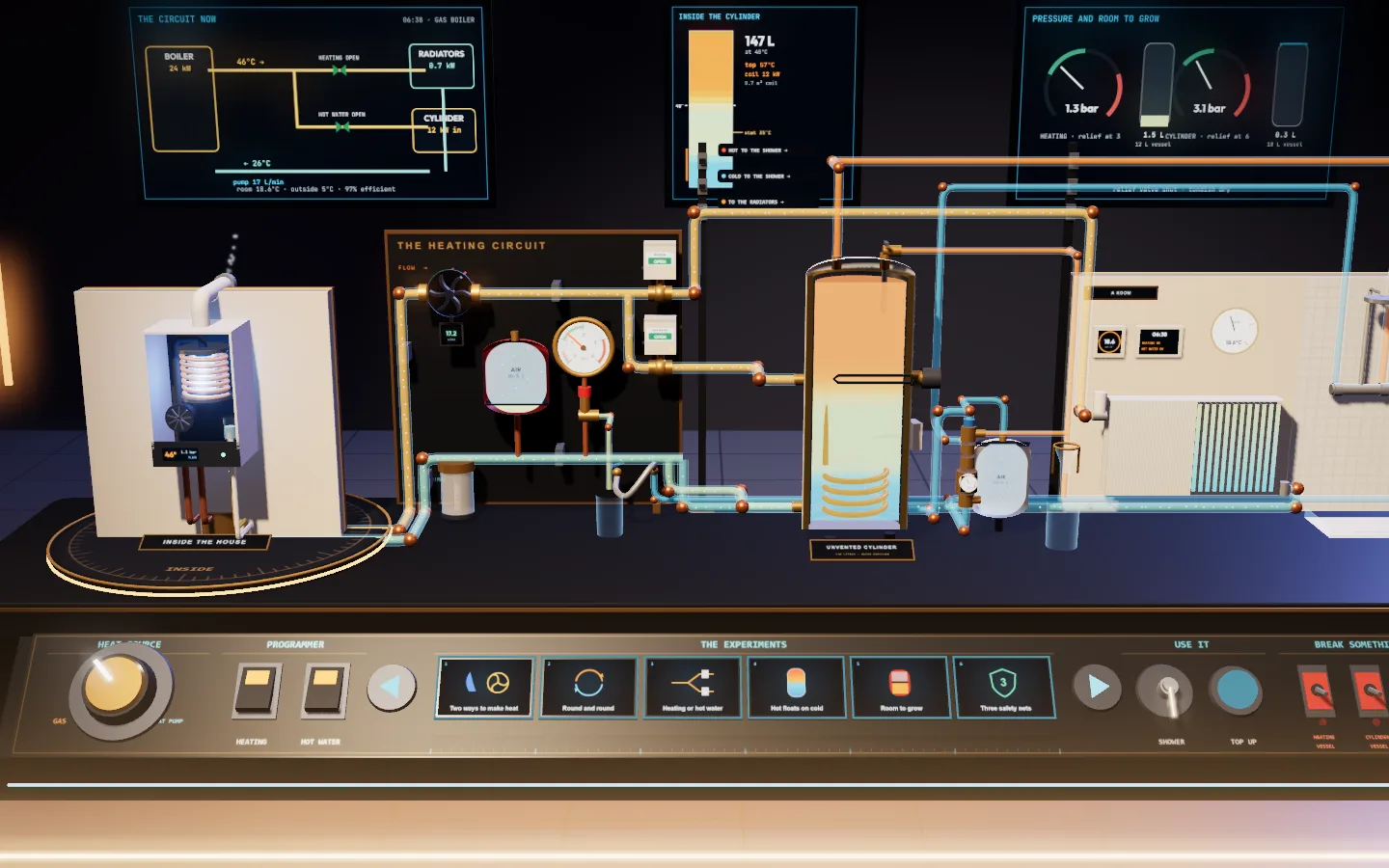
A gas boiler or an air source heat pump heats a sealed circuit of water. A pump sends it through two valves to the radiators and to a coil inside an unvented hot water cylinder, and two expansion vessels and a set of relief valves keep the pressures in hand. The lab lays all of it out on a bench, cut open, and asks six questions of it. Each answer here comes from the same model.
How heating and hot water work, in six experiments
Two ways to make heat
What does a boiler do, and what does a heat pump do differently?
A gas boiler makes heat by burning gas. A fan mixes gas with air, it burns across a stainless steel burner, and the hot gas passes over a coil with the heating water inside it. This one can give 24 kW and sends water out at 70°C. The cooler the water that comes back, the more heat it pulls from the gas: below about 55°C the steam in the flue gas condenses on the coil and gives up its heat too. Gross efficiency is about 97% with water coming back at 30°C, 90% at 50°C and 87% at 60°C. An air source heat pump moves heat instead of making it. Its fan draws outside air (5°C here) through a coil where a refrigerant boils, a compressor squeezes the gas until it is hot, and a plate heat exchanger passes that heat into the water. For 40°C heating water it gives about 3.8 units of heat for each unit of electricity; for 55°C hot water, about 2.8.
Round and round
Why does the same water go round, and why does a heat pump move more of it?
The heating circuit is sealed: about 100 litres of water go round and round, out to the radiators and the cylinder’s coil and back, pushed by a small pump. The heat is carried by the difference between the water going out and coming back. A boiler runs hot with a big difference, about 20 K, so carrying 5 kW takes only 3.6 litres a minute. A heat pump runs cooler with a small difference: its pump moves a steady 15 litres a minute, so the same 5 kW comes back only 4.8 K cooler. That is why heat pump systems use bigger pipes and bigger radiators: the water is cooler, so more of it, over more surface, has to do the same work.
Heating or hot water: zone valves
How does one heat source serve both the radiators and the cylinder?
Two motorised zone valves decide where the hot water goes, an arrangement called an S-plan. The room thermostat opens the heating valve, the cylinder thermostat opens the hot water valve, and a switch inside each valve’s head starts the boiler or heat pump once it is fully open. A boiler has heat to spare and serves both at once. A heat pump usually gives the hot water priority: the heating valve shuts while the cylinder reheats and the flow temperature rises from 40°C to about 55°C, then the heating takes over again. In a well-insulated house the rooms hardly notice the pause.
Hot floats on cold: inside the cylinder
How does the cylinder keep hot water ready, and why does a heat pump need a bigger coil?
Hot water is lighter than cold, so in the cylinder it floats on top. A shower draws from the top and mains water comes in at the bottom through a spreader so it doesn’t stir the hot water up, and the line between them (the thermocline) rises. At 60°C a 210 litre cylinder makes about 350 litres of 40°C water, 60% of each litre from the cylinder; at a heat pump’s 50°C it makes about 280. The thermostat sits a third of the way up. When the coil heats, the warm water rises off it to the top, so the cylinder heats from the top down. From cold, a boiler’s 0.7 m² coil reheats it in about 32 minutes. A heat pump sends cooler water, so its cylinder has a 3 m² coil: about 102 minutes at an average COP of 4.1. Fit a boiler’s small coil instead and the heat pump has to run hotter to push the same heat across, so the COP over the reheat falls to 3.8 and the last few degrees come slowly (104 minutes in all). On a heat pump that can’t run hotter, the water never reaches its temperature at all.
Room to grow: expansion vessels
Where does the water go when the heating warms up?
Water grows as it warms: the 100 litres in this circuit take up 2.2 litres more at 70°C than cold (0.8 litres at a heat pump’s 40°C). The circuit is sealed, so the extra pushes into a red expansion vessel, where it squeezes a cushion of air behind a rubber diaphragm. Filled to 1.2 bar cold, with the vessel’s 12 litres charged to 1 bar, the gauge rises to about 1.7 bar when the water is at 70°C and 1.3 bar at 40°C. The air slowly gets out through the rubber. With none left, warming the water takes the pressure straight to 3 bar and the relief valve lets about 2.2 litres out; when it cools the circuit is that much short and the gauge falls to 0.0 bar. Below 0.5 bar the boiler or heat pump locks out. Topping up with the filling loop only starts the cycle again: the fix is to recharge or replace the vessel.
Three safety nets on an unvented cylinder
What stops a sealed cylinder of hot water from overheating?
An unvented cylinder holds hot water at mains pressure, so it carries three layers of protection. Its thermostats stop the heating at 60°C (or 50°C). The immersion heater has its own cut-out that switches it off at about 80°C if its thermostat sticks, and stays off until someone resets it. If that fails too, the temperature and pressure relief valve on top opens at 90°C (or 7 bar) and lets hot water out through the tundish while cold mains water comes in, so the water can never boil. The cold side has its own protection. The inlet group holds the supply at 3 bar and its check valve stops water going back into the main, so when the cylinder heats with the taps shut its water has to go into the cylinder’s 18 litre expansion vessel: about 3.4 litres from 15°C to 60°C, which lifts it to 3.9 bar. If that vessel loses its air, the pressure reaches 6 bar and the relief valve lets about 3.4 litres out through the tundish on every reheat. A tundish that drips is the sign to call the installer.
Parts of a heating and hot water system
The gas system boiler
- Gas boiler
A system boiler: a sealed box on the wall that burns gas to heat the water going round the radiators and the cylinder’s coil. This one can make 24 kW, as much heat as eight kettles boiling at once, and turns itself down when less is needed.
A gas boiler must be fitted and serviced by an engineer on the Gas Safe Register.
- Burner and flame
A fan mixes gas and air before they reach the burner, a mesh of stainless steel where the flame burns blue across its whole surface. The gas valve opens only once the fan is running and a spark has lit the flame, and closes the moment a sensor stops seeing it.
The boiler varies the fan’s speed and the gas with it, so the flame can run from flat out down to about an eighth of that.
- Heat exchanger
The hot gas from the flame passes over a coil of stainless steel or aluminium with the heating water inside it. The cooler the water coming back, the more heat the boiler pulls out of the gas.
Below about 55°C coming back, the steam in the flue gas turns to water on the heat exchanger and gives up its heat too. That is what makes a boiler condensing, and why it is most efficient with cool return water.
- Flue
A pipe within a pipe: the outer one brings fresh air in for the flame and the inner one takes the burnt gas out. On a cold day you see a plume of steam from it.
The flue terminal has to sit set distances from windows, doors and boundaries, so its position is worth fixing early in the design.
- Condensate trap and pipe
The water the flue gas gives up is mildly acidic. It collects in a trap at the bottom of the boiler and runs away in a plastic pipe to a drain.
Run the condensate pipe indoors where you can. An outside run should be at least 32 mm, insulated, and kept short, because a frozen one stops the boiler.
The heat pump
- Air source heat pump
A box outside that takes heat from the air, even cold air, and lifts it to a temperature that can heat the house. It uses electricity to do the lifting, and gives out three to four times as much heat as it uses.
The heat pump lab takes one apart. A heat pump must be designed and fitted to the MCS standard for the Boiler Upgrade Scheme grant.
- Fan and coil
The big fan pulls outside air through a finned coil. The refrigerant inside the coil is colder than the air, so it soaks up the air’s heat and boils, even when the air is below freezing.
On damp days near freezing the coil ices up, and the unit runs a short defrost every hour or so.
- Compressor
Squeezing the refrigerant gas makes it hot, the way a bike pump gets warm. This is where the electricity goes. The harder it has to squeeze, the more power it takes for each unit of heat.
That is why the flow temperature matters so much: every degree lower saves a few percent on the bill.
- Plate heat exchanger
Thin stacked plates with the hot refrigerant on one side and the heating water on the other. The refrigerant gives up its heat to the water and turns back to liquid.
In a monobloc heat pump like this the refrigerant never leaves the box: it is the heating water that runs out to the unit, so the pipes outside are insulated and protected from freezing.
The sealed heating circuit
- Circulating pump
A small electric pump that pushes the same water round and round: out of the source, through the radiators or the cylinder’s coil, and back. Cut open you can see its impeller, a spinning wheel of curved vanes.
Modern pumps sense the pipework and adjust their speed, using 5 to 40 watts. A boiler usually has one inside its case; here it sits on the board where you can see it.
- Magnetic filter
Steel radiators slowly rust from the inside, and the rust becomes a black magnetic sludge (magnetite) that clogs pumps and heat exchangers. A strong magnet in this canister catches it on the way back to the source.
Most boiler and heat pump makers ask for a filter and an inhibitor in the water as a condition of the warranty. The filter is emptied at the yearly service.
- Pressure gauge
The circuit is sealed and filled to about 1.2 bar when cold. The needle rises as the water warms and grows, and falls back as it cools.
Somewhere between 1 and 2 bar is normal. A gauge that keeps falling means water is getting out: a leak, or a relief valve opening because the expansion vessel has lost its air.
- Heating expansion vessel
A red steel tank split by a rubber diaphragm: air on one side, the circuit’s water on the other. When the water warms it grows by about 2.2% at 70°C, and the extra pushes into the vessel and squeezes the air. Without that cushion the pressure would shoot up.
This one holds 12 litres and its air is charged to 1 bar through a tyre valve. The air slowly gets out through the rubber, so it is checked at the yearly service.
- Pressure relief valve
A spring-loaded valve that opens at 3 bar and lets water out through a pipe to the outside. It is the circuit’s last line of defence against too much pressure.
If it opens every time the heating warms up, the expansion vessel has usually lost its air. Each time some water goes, and the gauge drops a little lower the next morning.
- Filling loop
A short braided hose with a valve at each end that joins the cold main to the sealed circuit. Open the valves and mains water tops the circuit up, watching the gauge until it reads about 1.2 bar.
The water rules treat it as a temporary connection: the hose must be taken off after use, so the heating water (with its inhibitor) can never get back into the drinking water.
- Heating zone valve
A motorised valve on the pipe to the radiators. When the room thermostat asks for heat, its motor drives the valve open, and a switch inside tells the source to start.
Open, the lever on its head sits over to one side; you can also push it across by hand to open the valve if the motor fails.
- Hot water zone valve
The same kind of valve on the pipe to the cylinder’s coil, opened by the cylinder thermostat. Two valves like this is called an S-plan. With a boiler both can be open together.
Heat pump systems usually give hot water priority: the heating pauses while the cylinder reheats. A three-way diverter valve often does the switching.
The unvented hot water cylinder
- Unvented cylinder
A steel tank wrapped in thick foam that holds hot water at mains pressure, so showers run strong anywhere in the house. Hot water is lighter than cold, so it floats on top, and the cold that comes in at the bottom to replace what you use stays below it.
Building Regulations Part G3: an unvented cylinder must be fitted by a registered installer who holds the unvented qualification, and building control told.
- The coil
The heating water runs through a copper or steel coil inside the cylinder and warms the stored water without ever mixing with it. A boiler’s water arrives at 70°C, so a small coil (about 0.7 m²) is enough.
A heat pump sends water at about 55°C, much closer to the water it is heating, so its cylinder needs a far bigger coil (about 3 m²) to pass the heat across. A boiler cylinder on a heat pump is a common and costly mistake.
- Cylinder thermostat
A sensor in a pocket a third of the way up. When the water there cools it opens the hot water zone valve, and when it is back up to temperature it shuts it: 60°C on a boiler, about 50°C on a heat pump.
Alongside it is a high-limit thermostat that shuts the zone valve if the water ever gets too hot.
- Immersion heater
An electric element, like a big kettle element, screwed into the side of the cylinder. Here it is the backup, used if the boiler or heat pump fails.
It has its own thermostat and a separate cut-out that switches it off at about 80°C if that thermostat sticks, and stays off until someone resets it. A heat pump system often uses it once a week to lift the whole cylinder to 60°C against Legionella.
- Cold main and stop tap
Mains water from the street at about 10°C in winter. The stop tap here shuts off the whole house; learn where yours is before you need it.
An unvented cylinder needs a good supply: makers usually ask for at least 1.5 bar and 20 litres a minute at the stop tap.
- Inlet control group
A brass block on the cold main into the cylinder with four jobs: a strainer catches grit, a pressure-reducing valve holds the water at 3 bar, a check valve stops hot water pushing back into the main, and a relief valve opens at 6 bar if the pressure ever climbs that far.
A cold take-off from the group feeds the showers, so their hot and cold are at the same pressure and a thermostatic mixer can keep the temperature steady.
- Cylinder expansion vessel
The cylinder’s own vessel, for the same reason as the heating’s: water grows as it heats, and with the check valve shut it has nowhere to go. This one holds 18 litres with its air charged to 3 bar.
It is white (or blue) because drinking water passes through it, with a food-safe diaphragm. The red ones are for heating water only.
- Temperature and pressure relief valve
The last resort, on top of the cylinder. If the water reaches 90°C, or the pressure 7 bar, it opens and lets hot water out, and cold mains water rushes in to replace it. Water that hot can never reach boiling inside the tank.
It should only ever open after two thermostats and a cut-out have all failed. If it opens, call the installer.
- Tundish
A funnel with an air gap, where the cylinder’s relief valves discharge. Through its window you can see water running when it should not, and the gap means the drain can never be sucked back into the pipes.
A tundish that drips when the cylinder heats up nearly always means the cylinder’s expansion vessel has lost its air. The pipe on from it must fall to a safe place where scalding water can’t hurt anyone.
In the house
- Radiator
Hot water flows in at the top and leaves cooler at the bottom, warming the room mostly by heating the air that rises past it. With a boiler the water arrives at 70°C; with a heat pump at about 40°C, so a heat pump house needs bigger radiators, or underfloor heating, to give the same heat.
Radiators are rated by the heat they give with the water 50°C warmer than the room. At 20°C warmer they give about a third of that.
- Room thermostat and programmer
The programmer turns the heating and the hot water on and off through the day. The thermostat in the living room switches the heating within those times, holding the room at the temperature you set.
Thermostatic valves on the radiators in other rooms let each room run cooler. With a heat pump, set it and leave it: it works best running gently all day.
- Shower
A thermostatic mixer blends hot from the top of the cylinder with cold from the main to give a steady 40°C. Every litre of hot that leaves the top is replaced by cold coming in at the bottom.
With the cylinder at 60°C, 60% of a 40°C shower comes from the cylinder and the rest from the cold main.
Vented and unvented cylinders
Many older homes have a vented cylinder, fed by gravity from a cold water tank in the loft. An open vent pipe rises from its top and turns down over that tank, so its pressure is only what the tank’s height gives: about 0.1 bar a metre, which is why showers on the floor below the loft are often weak unless pumped. Being open to the air, it needs no expansion vessel or pressure relief valves. An unvented cylinder takes water from the main at 3 bar with no loft tank, which makes it the usual choice in a new house. A combi boiler has no cylinder: it heats water as it flows, which suits a home with one bathroom. A heat pump can’t make hot water that quickly, so it heats a store, usually a cylinder.
Regulations for boilers, heat pumps and cylinders
- Part G3: hot water
An unvented cylinder needs a thermostat, a cut-out and a temperature and pressure relief valve, discharge through a visible tundish to a safe place, and installation by someone competent: usually a registered installer who holds the unvented qualification and self-certifies the work.
- Part L: heating
A new wet heating system must be designed to run with a flow temperature of 55°C or less, which suits heat pumps and makes boilers condense. Each room needs its own temperature control, usually thermostatic radiator valves.
- Future Homes Standard: gas boilers in new homes
A new edition of Approved Document L, known as the Future Homes Standard, applies to new homes in England from 24 March 2027. It is set so that new homes are built with low carbon heating: the reference home its energy and carbon targets come from is heated by an air source heat pump, which leaves little room for a gas boiler. A new home whose building notice, initial notice or full plans application goes in before 24 March 2027 can still be built to the 2021 rules if its foundations and ground floor structure are complete before 24 March 2028.
- Gas Safe and MCS
A gas boiler must be fitted by a Gas Safe registered engineer. A heat pump fitted by an MCS certified installer, to the MCS standard, can qualify for the Boiler Upgrade Scheme grant.
- Legionella
HSE guidance is to store hot water at 60°C or more. A heat pump storing it cooler usually lifts the whole cylinder to 60°C once a week, often with the immersion heater.
- Water Supply (Water Fittings) Regulations 1999
Approved fittings and protection against backflow: the check valve in the inlet group, the air gap in the tundish, and a filling loop that is disconnected after use so heating water can never get back into the drinking water.
The model is a well-insulated three-bed house (the heat pump lab’s) on a 5°C winter morning, with 10°C mains water, a 210 litre cylinder, a 24 kW system boiler or a 6 kW heat pump, and radiators sized for the heat pump. The heat pump is the heat pump lab’s 4 kW unit scaled up to 6 kW, so it reheats this cylinder from cold in about 102 minutes. The model’s temperatures, pressures and flows use real units and simple sums, so the numbers are the right size rather than exact for any one home. The exhibit enlarges the small parts so they read from across the room. The soil and waste pipes have their own lab. None of this is a guide to doing the work yourself: heating and hot water systems are installed by qualified engineers, and an unvented cylinder by a registered installer.
Questions people ask
How does an unvented hot water cylinder work?
An unvented cylinder is a sealed tank fed straight from the cold main, so it stores hot water at mains pressure and, with a good supply, showers run strong anywhere in the house. Makers usually ask for at least 1.5 bar and 20 litres a minute. Water from the boiler or heat pump heats the store through a coil, without mixing with it. Being sealed, it needs an inlet group holding the supply at 3 bar, an expansion vessel and a relief valve that opens at 90°C or 7 bar.
Why does my boiler pressure keep dropping?
Boiler pressure that keeps dropping means water is leaving the heating circuit, through a leak or the pressure relief valve. The valve usually opens because the expansion vessel has lost its air. In the lab’s 100 litre circuit, warming the water then takes the pressure to 3 bar, about 2.2 litres go out, and once cold the gauge reads 0 bar, so the boiler locks out. A healthy circuit usually reads 1 to 2 bar. Topping up just restarts the cycle until the vessel is recharged or replaced.
Why is my tundish dripping when the cylinder heats up?
A tundish that drips as the cylinder heats usually means the cylinder’s own expansion vessel has lost its air; a worn relief valve or a failing pressure reducing valve can cause it too. With the taps shut, a check valve seals the cylinder, so its 210 litres have to grow into that vessel: about 3.4 litres from 15°C to 60°C. With no air left the pressure reaches 6 bar and the expansion relief valve lets about 3.4 litres out through the tundish on every reheat. Call the installer.
Do I need a special hot water cylinder for a heat pump?
Yes: a heat pump needs a cylinder with a much bigger coil than a boiler’s. A boiler’s water arrives at 70°C, so a coil of about 0.7 m² is enough. A heat pump heats hot water at about 55°C, close to the water it warms, so its cylinder has a coil of about 3 m². In the lab, reheating a cylinder from 15°C, a heat pump averages a COP of 4.1 through the big coil and 3.8 through a boiler’s small coil, falling towards 2.8 as the water nears 50°C. Through the small coil, a heat pump that can’t run hotter never gets the water to temperature.
How many showers does a 210 litre hot water cylinder give?
A full 210 litre cylinder at 60°C gives about 350 litres of 40°C water once it is mixed with 10°C mains water: 35 minutes of a 10 litre a minute shower, or four showers of 8 minutes. At a heat pump’s 50°C it gives about 280 litres, 28 minutes. Those are best cases, since water at the line between hot and cold is lukewarm. From cold, a boiler reheats it in about 32 minutes and a 6 kW heat pump in about 102.
Can I fit a gas boiler in a new build?
In England, a gas boiler is only realistic in a new home that can still be built under the 2021 energy rules. The Future Homes Standard applies to new homes from 24 March 2027. Its targets come from a reference home heated by an air source heat pump, leaving little room for gas. A new home whose building notice, initial notice or full plans application goes in before 24 March 2027 can still be built to the 2021 rules if its foundations and ground floor structure are complete before 24 March 2028.