The written version
Heat pump: heat from cold air
These labs are a visualisation aid to help you picture how a house works. They are not technical advice: the models and figures are simplified, so please don't rely on them for design, specification or buying decisions. Ask a qualified designer, engineer or installer about your own home.
An air source heat pump moves heat out of the outside air and into your heating water, even on a frosty morning. What it costs to run comes down to three things: how warm the water has to be, how big the radiators or floor are, and the weather.
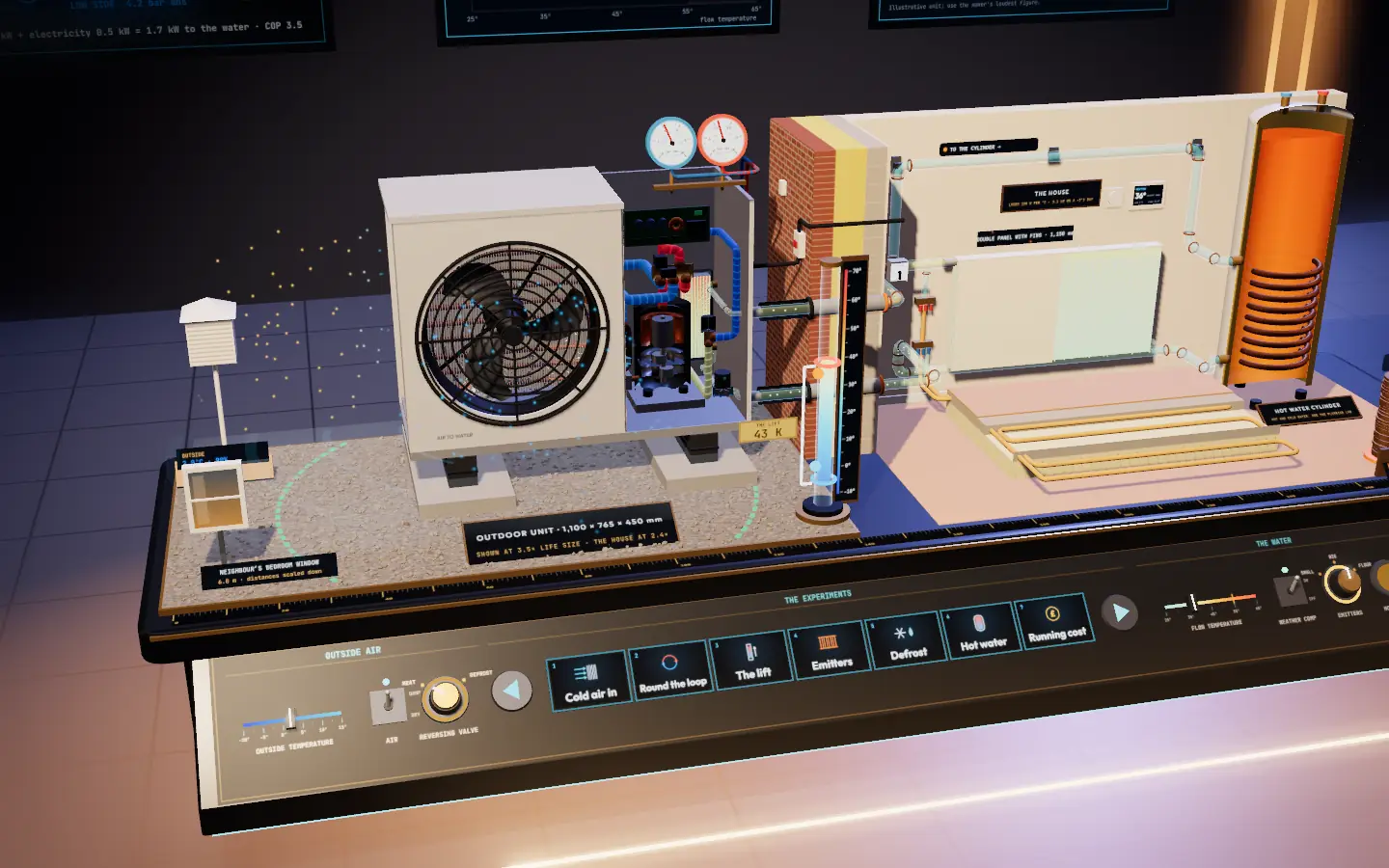
The lab is a museum exhibit: one monobloc outdoor unit at 3.5 times life size on a gravel bed (the house beside it is at 2.4 times, so the unit is shown bigger than it would be), with its casing on, cut open or exploded, so you can see the fan, the coil, the compressor, the valves and the plate heat exchanger that hands the heat to the water. Its pipes run through a slice of house wall to a diverter valve, the radiators or underfloor heating and a hot water cylinder, and a desk along the front runs seven experiments.
The experiments, in words
Heat from cold air
How can air at 2°C heat a house? Open the unit and the coil wraps round its back and side: hundreds of thin aluminium fins on copper tubes, with the fan behind the round grille at the front. Air at 2°C is 275 degrees above absolute zero, so it still holds plenty of heat; it only feels cold because we live at 21°C. In the coil the refrigerant, propane, is held at about 4.2 bar, where it boils at about −4°C: colder than the air. Heat flows from warm to cold, so the air warms the refrigerant and it boils. On a 2°C day the fan pulls about 1,600 m³ of air an hour through the fins and sends it out about 2.1 degrees colder, which gives the refrigerant about 1.2 kW of heat.
Round the loop
What is the electricity for? The compressor squeezes the vapour to about 13.4 bar, and the work of squeezing heats it to around 70°C. In the plate heat exchanger it condenses at about 39°C, a little warmer than the water, and gives its heat to the heating water, which leaves at 36°C and runs round the house at about 9 litres a minute. Through the expansion valve its pressure drops back to 4.2 bar, about 28% of the liquid flashes to vapour and chills the rest, and it comes out at −4°C, ready for the next lap. About 4.4 grams of propane go round every second. The electricity pays for the squeeze: about 450 W goes to the compressor and only 11 W to the fan. The water gets the heat from the air and the electricity together: on a 2°C day 1.2 kW from the air plus 0.5 kW of electricity makes 1.7 kW of heat, a coefficient of performance (COP) of about 3.5.
Hotter water, harder work
Why does the flow temperature matter so much? The refrigerant has to boil a few degrees below the outside air and condense a few degrees above the heating water. The gap between the two is the lift, and the bigger the lift, the harder the compressor works for each unit of heat. At 7°C outside this model gives a COP of 4.6 with the water at 35°C and 2.9 at 55°C, close to the test figures manufacturers publish for small units; a perfect (Carnot) machine working between the same refrigerant temperatures would manage 8.4, and real ones get about half of that. Hold this house at 55°C on a 7°C day and the lift is 57 K and the COP 2.8; weather compensation would run it at 31°C, a lift of 33 K, for a COP of about 5.0. Over a typical year that gives a seasonal COP of 4.1 with radiators sized for a heat pump, against 3.2 with the flow held at 45°C all winter.
Big radiators, cool water
Why does a heat pump want bigger radiators? The radiators or floor decide how warm the water has to be. An MCS designer sizes them for the whole heat loss on a −3°C design day (London’s; MCS uses the figure for your area, which can be a few degrees colder), 3.1 kW for this house, with no help from free heat. Radiators sized for a gas boiler need water at about 64°C to give that, well over the 55°C that Approved Document L asks for in a new system. Radiators with 2.3 times their output need about 45°C, and underfloor heating about 35°C. On a real −3°C day, people, cooking and appliances give about 750 W, so the house needs 2.4 kW and weather compensation runs the three at about 56°C, 40°C and 31°C. In a self-build it costs little to plan for the larger emitters from the start.
A freezing, damp morning
What happens when the coil ices up? Below about 6°C in damp air the coil fins run below freezing and frost builds on them until it blocks the air. Then the unit defrosts for about 7 minutes. The fan stops and the reversing valve flips, so the hot gas goes to the coil instead of the water and the refrigerant runs the other way round. The ice melts, steam rises off the fins and the water runs out of the base tray into the gravel; then the valve flips back and the fan restarts. In this model, at 2°C and 90% humidity, the coil needs a defrost after about 73 minutes of running, and defrosting costs about 10% of the output. A full coil holds about 2.5 kg of ice, so a whole day of that weather means 18 defrosts and about 45 litres of water down the drain. In drier air at the same temperature the ice builds about 9 times more slowly, and in a hard freeze the air holds less water, so frost builds more slowly too.
Hot water
Why does hot water cost more than heating? Once or twice a day the diverter valve sends the flow to the coil in the cylinder instead of to the heating. Heating 200 litres from 42°C to 50°C takes about 30 minutes, with the flow climbing towards 55°C while the rooms coast on the heat already in them. The hotter water means a bigger lift: at 2°C outside the COP averages about 2.5 over the reheat, against 3.5 for heating the rooms, so a unit of hot water costs more than a unit of heating. Many systems also lift the cylinder to 60°C once a week to control legionella, which costs a little more.
What it costs to run
Is it cheaper to run than a gas boiler? A kWh of electricity costs 26.32p and a kWh of gas 7.97p, and a 90% efficient boiler turns gas into heat at 8.9p a kWh. The heat pump’s heat costs the electricity price divided by its COP (7.6p a kWh at a COP of 3.5), so at these prices it is the cheaper of the two whenever its COP is above 3.0. Over a typical English year (Met Office averages, about 2,200 degree days) this house needs about 6,700 kWh of heating and 1,800 kWh of hot water. With radiators sized for a heat pump and weather compensation, that takes about 2,200 kWh of electricity: about £570 a year, against £750 for gas. With underfloor heating it costs about £520. With boiler-sized radiators it costs about £680, or £950 if the flow is fixed at 64°C, which costs more than gas.
The parts
Inside the outdoor unit
- Monobloc outdoor unit
A monobloc heat pump puts the fan, the coil, the compressor and the whole refrigerant circuit in one sealed steel cabinet outside, and only water pipes go into the house. This one is shown at 3.5 times life size, bigger than the house beside it so you can see inside; the real thing is 1,100 mm wide, 765 mm high and 450 mm deep and weighs about 128 kg. Use the casing control to take its panels off.
At about 0.38 m³ it is well inside the 1.5 m³ that permitted development allows for a heat pump at a house in England.
- Fan and guard
A large, slow propeller fan behind a spiral guard pulls outside air in through the coil at the back and side and blows it out of the front a couple of degrees colder. Its motor speeds up as the load rises and stops while the unit defrosts.
Give the unit room: cold air that blows against a wall and curls straight back into the coil lowers the COP. Each maker sets clearances round the unit, typically a few hundred millimetres behind it and a metre or more in front.
- Evaporator coil
Hundreds of thin aluminium fins on copper tubes, wrapped round the back and one side of the unit behind a guard. Inside the tubes the refrigerant is colder than the air, so heat flows into it and it boils, even when the air is below freezing.
Propane (R290) boils at −4°C at about 4.2 bar, so air at 2°C is warm enough to boil it. In damp air near freezing the fins collect frost, which the unit melts off from time to time.
- Compressor
A twin rotary compressor: two rollers turn off-centre inside two cylinders, each sweeping vapour into a shrinking space, half a turn apart so it runs smoothly. Squeezing the vapour from about 4 bar to 13 bar heats it to around 70°C. An inverter changes its speed to match the load, and it sits on rubber mounts inside a felt jacket to keep it quiet.
Small units use rotary compressors like this one; larger ones often use a scroll. Every watt the compressor uses ends up in the water too, along with the heat taken from the air.
- Accumulator
The steel can on the compressor’s side. Vapour on its way to the compressor passes through it, and any drops of liquid fall to the bottom and stay there. A compressor is built to squeeze vapour, and liquid can damage it.
It matters most just after a defrost, when the coil can send liquid back for a short while.
- Reversing valve
A four-way valve beside the compressor, with a small electric coil on top that moves a slide inside it. For heating it sends the hot gas to the plate heat exchanger. To defrost it flips for a few minutes and sends the hot gas to the coil instead, so the ice melts.
You often hear it as a hiss when a defrost starts and ends. The cloud of steam that rises off the coil is the ice melting, and is normal.
- Expansion valve
A small electronic valve with a stepper motor on top. The warm liquid squeezes through a tiny opening, its pressure drops from about 13 bar to 4, and about a quarter of it flashes to vapour, which chills the rest. It comes out colder than the outside air, ready to take heat from it again.
The controller trims the opening many times a minute so the vapour leaves the coil just a few degrees warmer than it boiled.
- Plate heat exchanger
Stacked stainless steel plates brazed together, with refrigerant between every other pair and heating water between the rest, flowing opposite ways. The hot gas condenses back to a liquid and hands its heat to the water.
The refrigerant condenses a few degrees above the flow temperature, so a lower flow means a lower pressure for the compressor to reach.
- Water pump
A circulating pump on the return, inside the cabinet. It pushes the heating water through the plate heat exchanger, out to the house and back, about 9 litres a minute in this house.
The water side needs a minimum flow; a unit that cannot get it stops to protect itself. That is one reason heat pump systems avoid valves that can shut every radiator at once.
- Inverter and controls
The circuit board that runs the unit. It turns the mains supply into the varying frequency that sets the compressor’s speed, and reads the temperature and pressure sensors round the circuit. Its finned heatsink sits in the stream of cold air so the fan cools it.
Because the inverter can slow the compressor down, the unit turns itself down on mild days instead of switching on and off.
The refrigerant loop
- Low-pressure side
From the expansion valve, through the coil and back to the compressor, the refrigerant is cold and at low pressure: a mix of liquid and vapour into the coil, cold vapour out of it. This is where heat comes in from the air. The pipe back to the compressor is lagged.
- High-pressure side
From the compressor to the expansion valve the refrigerant is hot and under pressure: hot gas into the plate heat exchanger, then a warm liquid out of it. This is where the heat goes into the water.
- Pressure gauges
An engineer’s pair of gauges on the service ports: blue for the low side, red for the high side. A refrigerant’s boiling point follows its pressure, so each pressure tells you the temperature at which it boils or condenses. These read absolute pressure; an engineer’s gauge reads about 1 bar less.
Water does the same: it boils at 100°C at sea level and at about 70°C at the top of Everest.
- The temperature lift
The glass column shows the four temperatures that matter. The refrigerant boils a few degrees below the outside air and condenses a few degrees above the heating water. The gap between the two is the lift, and the bigger the lift, the more work the compressor does for each unit of heat.
The ideal (Carnot) COP is the condensing temperature in kelvin divided by the lift. A real unit gets about half of it.
Outside
- The outside air
The weather station reads the air the heat pump works on: its temperature and how damp it is. Air at 2°C is 275 degrees above absolute zero and still holds plenty of heat. It only feels cold because we live at 21°C.
The heat pump needs a great deal of air because it takes only a couple of degrees out of each cubic metre.
- Base tray, drain and soakaway
Meltwater from each defrost runs into the base tray and out through the drain into a bed of gravel. Let it soak away; dripping onto a path or patio, it freezes.
In this model a fully iced coil holds 2.5 kg of ice, so each defrost sends about 2.5 litres down the drain. On a raw, damp day that adds up to tens of litres, so plan the soakaway when you design the garden.
- Feet and base
The unit stands on rubber anti-vibration feet on a firm, level base: a concrete pad, paving on a solid bed, or a ground frame. The feet stop the compressor’s hum travelling into the ground and the house, and lift the unit clear of snow and standing water.
Avoid hanging a unit on the wall of a bedroom: brackets carry vibration into the structure.
- Electricity in
The only energy you pay for. An armoured cable from its own circuit in the consumer unit runs to an isolator, placed where the maker’s instructions allow (for a propane unit, outside its safety zone), and in through a cable gland. The electricity drives the compressor, the fan, the water pump and the controls. It does not heat the water directly: it does the work of lifting heat from the cold side to the warm side.
A heat pump needs its own circuit and usually a type B or similar RCD, as the maker’s instructions set out. Tell your electrician early. The network operator must be told about a heat pump; on a self-build, put it on your new connection application.
- Siting and noise
In England a heat pump at a house is usually permitted development if the MCS 020(a) calculation shows 37 dB(A) or less 1 m outside every neighbouring habitable room window or door. It starts from the unit’s sound power from the maker’s data (its energy label, product fiche or the MCS product directory, never a low-noise mode), adds for walls within 1 m (the ground counts as one), takes off for distance and for a solid wall or fence that hides the unit. With a 55 dB(A) unit against one wall, the point 1 m outside the window needs to be about 4.5 m from the middle of the unit, so a window facing it about 5.5 m.
Since 29 May 2025 a unit can be up to 1.5 m³ and within 1 m of the boundary, and a detached house can have two. For a propane unit the maker’s safety zone usually cannot cross the boundary, so it may still need to sit back from it. A fence or wall only counts as a barrier if it is solid with no gaps and runs at least 1 m past each side of the unit; slatted fences and hedges count for nothing. For a new self-build, show the unit on your planning drawings: permitted development rights apply once the house exists, and a condition on the permission can remove them.
Into the house
- Where the pipes go in
The flow and return pass through the wall in a sleeve, lagged all the way and sealed on the inside with airtight tape or a grommet so the hole does not leak warm, damp air into the wall. Outside, the lagging needs a weatherproof, UV-proof cover.
Plan the hole at the design stage: a short, straight run from the unit through the wall saves heat and pumping. The water in a monobloc runs outside, so ask how it is protected from freezing in a power cut: antifreeze, a separating heat exchanger or anti-freeze valves.
- Outdoor sensor
A small sensor on a shaded north wall that tells the controller how cold it is outside, so it can pick the flow temperature before the rooms start to cool.
Keep it out of the sun and away from the unit’s cold air, or it reads the wrong weather.
- Flow and return pipes
Insulated pipes carry warm water from the unit to the rooms and the cylinder, and back. The flow leaves warm; the return comes back a few degrees cooler, having given its heat away.
Heat pumps move more water than boilers at a smaller temperature drop, so their pipes are often a size bigger: 28 mm where a boiler might use 22 mm.
- Diverter valve
A motorised valve that sends the warm water either to the heating or to the coil in the hot water cylinder. The heat pump does one job at a time.
While the cylinder reheats, the rooms coast on the heat already in the radiators, floor and walls.
- Controller
The heat pump’s own controls and the room thermostat. With weather compensation on, it sets the flow temperature from the outdoor temperature: cooler water on mild days, warmer on cold ones.
Approved Document L asks for new heating systems designed to run at 55°C flow or lower.
- Radiators
A radiator’s output falls quickly as the water cools: at a mean of 40°C in a 21°C room it gives under 30% of its rated output. Bigger or double-panel radiators give the same heat from cooler water.
Output = rated output × (ΔT ÷ 50)^1.3, where ΔT is the mean water temperature minus the room temperature.
- Underfloor heating
Pipes in the screed turn the whole floor into a large, gentle radiator. Because the area is so big, water at 30–35°C is enough to heat a well-insulated room.
A floor slab warms and cools slowly, so set it and leave it rather than switching it on and off.
- Hot water cylinder
A well-insulated tank with a large coil inside. A heat pump heats water more gently than a boiler, so the coil is bigger and the cylinder stores enough for the day. Hot water rises, so the tank fills with heat from the top down.
Heating water to 50°C needs a flow of 55°C or so, which is why hot water costs more per kWh than heating. Many systems also lift the cylinder to 60°C once a week to control legionella, which costs a little more.
- The heat the house needs
Insulation sets how much heat the house needs. This one loses 130 W for every degree between inside and out, so on a −3°C day at 21°C indoors it loses 3.1 kW. Free heat from people, cooking and appliances covers some of that, but the heating is sized for all of it.
Halve the heat loss and the heat pump can run cooler water through smaller emitters.
What the rules and grants say
- Building Regulations
In England, Approved Document L (2021) asks for a new wet heating system with its pipes and emitters sized to heat the home at a flow temperature of 55°C or lower. The Future Homes Standard regulations, published on 24 March 2026, come into force on 24 March 2027 and are designed so that new homes are built with low carbon heating and high levels of energy efficiency. A home with a building notice, an initial notice or a full plans application given before 24 March 2027 can be built to the 2021 rules if the work starts before 24 March 2028. Wales and Scotland set their own rules.
- MCS design and the performance estimate
An MCS certified installer designs to the heat pump design standard, MIS 3005-D, and sizes the heat pump from a heat load calculation to BS EN 12831. When they quote, they have to give you a performance estimate made the standard MCS 031 way, so you can compare installers on the same basis.
- Noise: the MCS 020(a) calculation
To be permitted development the installation has to pass MCS 020(a) at every neighbouring habitable room window or door: 37 dB(A) or less, 1 m outside it. Since the transition ended on 28 May 2026 it is the only calculation accepted. The installer takes the unit’s declared sound power from its energy label, product fiche or the MCS product directory (never a quiet mode), adds for the surfaces within 1 m that reflect sound (Q is 2 for the ground alone, 4 against one wall, 8 in a corner), takes off for the distance from the middle of the unit to the point 1 m outside the window, and takes off 5 or 10 dB for a solid fence or wall that hides the unit from the window. A barrier only counts if it is solid with no gaps and runs at least 1 m past each side of the unit; slatted fences and hedges count for nothing. For a unit of 55 dB(A) against one wall, that point gets 34.5 dB(A) when it is 6 m from the unit, and the nearest it can be is about 4.5 m, so a window facing the unit needs to be about 5.5 m away. Tuck the same unit into a corner and that grows to 6.3 m: at 6 m it gives 37.5 dB(A) and fails, until a solid fence between them brings it down to 32.5 dB(A). Behind a brick wall, the point can be as close as 1.4 m to a unit against one wall. Two units heard at the same window add up: two that each give 34.5 dB(A) make 37.5 dB(A).
- Propane and where it can go
Propane (R290): 0.9 kg in a sealed circuit, with a global warming potential of 3 against 675 for R32. Propane burns, so the maker marks a zone round the unit, about 1 m in the open and more against a wall or in a corner, that must be kept clear of openings into a building, such as windows, doors, air bricks, vents and light wells, and of anything that could make a spark: outdoor sockets, lights, switches and the isolator. The zone must also stay inside your own land and off paths and drives. Propane is heavier than air, so any leak would sink and collect; keep the zone away from dips and open drains where it could pool.
- Boiler Upgrade Scheme
The scheme pays £7,500 towards an air source heat pump. Homes built by a developer are not eligible, but a self-build is if it was built mainly with your own labour or money (doing it yourself or paying a builder), has never been owned by a business or organisation and is not part of an excluded property development. The home must be in England or Wales. The installer must be MCS certified and applies for you. They must apply no more than 120 days after the heat pump is commissioned, so on a self-build ask them to apply as soon as it is commissioned, even if you have not moved in yet. If they apply before installing, the voucher lasts 3 months.
- Planning
In England an air source heat pump at a house is usually permitted development. Since 29 May 2025 a unit can be up to 1.5 m³ and within 1 m of the boundary, and a detached house can have two. For a propane unit the maker’s safety zone usually cannot cross the boundary, so it may still need to sit back from it. Listed buildings and conservation areas have tighter rules, so check with the council there. For a new self-build, show the unit on your planning drawings: permitted development rights apply once the house exists, and a condition on the permission can remove them.
The model is a well-insulated 3-bed self-build of about 110 m² that loses 130 W for every degree between inside and out, held at 21°C, with about 750 W of free heat from people, cooking and appliances and a 4 kW monobloc heat pump. The noise figures use an illustrative sound power of 55 dB(A); use the declared figure for the unit you choose, from its energy label, product fiche or the MCS product directory. Its COP is a fixed share of the ideal (Carnot) COP, fitted to a small unit’s published test data. Hot water is 5 kWh a day, cylinder losses included: an average household of two or three people; a family of four uses about 40% more. The year uses Met Office monthly mean temperatures for England (1991–2020). Prices are examples from the Ofgem price cap for October to December 2026, paying by direct debit, without standing charges; a home with no gas supply also avoids the gas standing charge of 29.68p a day. Electricity carries no VAT from October 2026 to March 2027; at 27.64p with VAT the year costs about £600. In existing homes, the Electrification of Heat trial measured a median seasonal performance factor (a whole-year COP, counting the pumps and any immersion heater) of 2.8 for air source heat pumps, so treat the seasonal figures here as what good design in a new, airtight house makes possible. The sums are simple but use real units, so the numbers are the right size rather than exact for any one home.
← All labs