The written version
MVHR exhibit: follow the air, keep the heat
These labs are a visualisation aid to help you picture how a house works. They are not technical advice: the models and figures are simplified, so please don't rely on them for design, specification or buying decisions. Ask a qualified designer, engineer or installer about your own home.
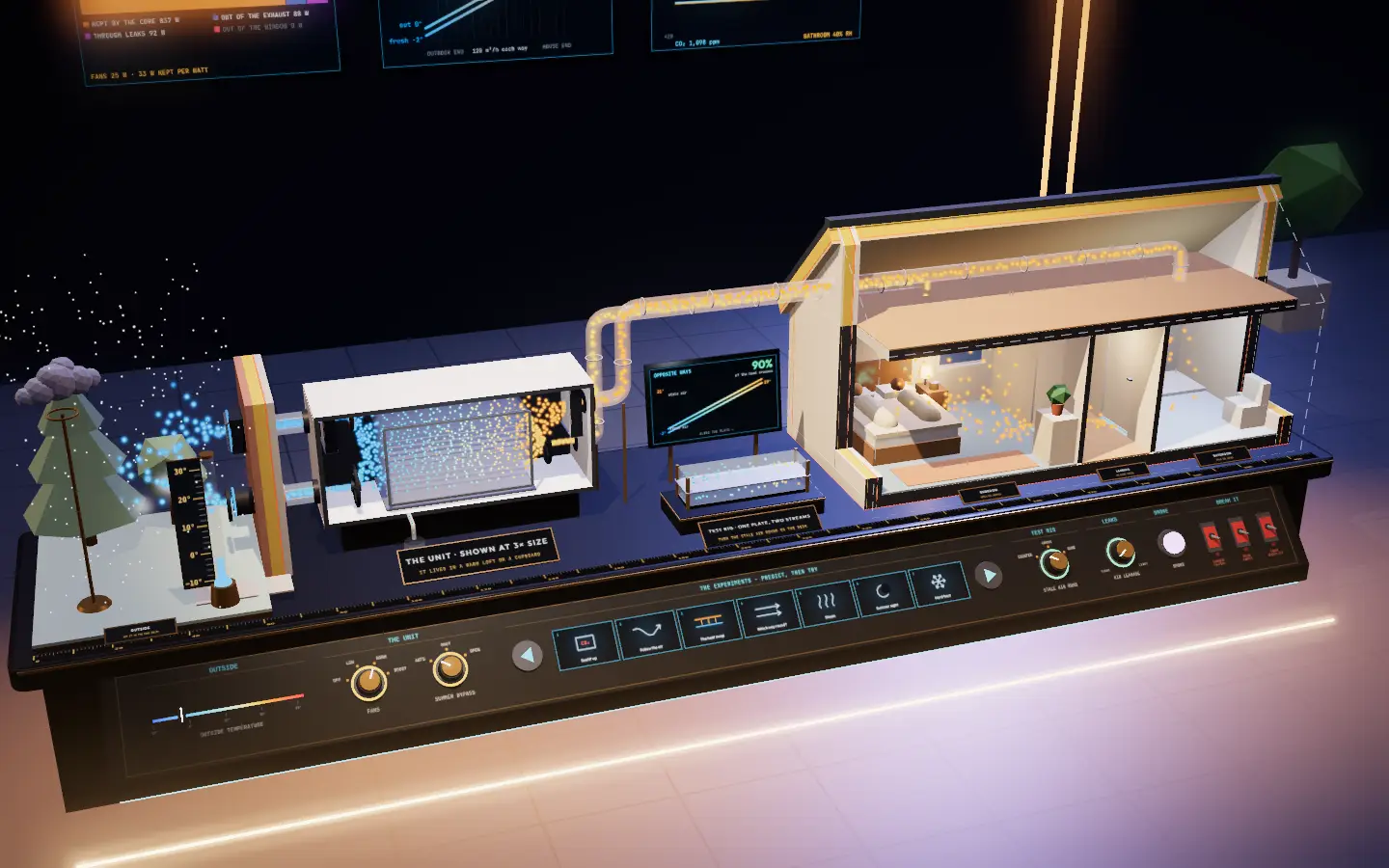
This exhibit lays a heat recovery ventilation system out along a bench, so the air can be followed from the garden, through the unit, round a bedroom and a bathroom and back out again. Each of its seven experiments asks what you think will happen before it shows you.
Seven MVHR experiments and what they show
An airtight house with the ventilation off
How long until the bedroom air is stuffy (1,500 ppm of CO₂)? Under an hour. Two people at rest breathe out about 30 litres of CO₂ an hour. In the model's bedroom, with the door shut and the fans off, the air passes 1,500 ppm about 53 minutes later and keeps climbing by about 1,000 ppm an hour. An airtight house lets almost none of it out, which is why it needs ventilation that runs all the time.
The path air takes through the house
Where will the smoke leave the house? Through the bathroom. Fresh air arrives at the bedroom's ceiling valve and nudges the room's air towards the door. It leaves under the door through a gap of about 10 mm, crosses the landing, goes under the bathroom door and up the extract valve. With the fans at their normal rate the bedroom settles at about 720 ppm with its door open and 1,150 ppm with it shut. Boost brings the shut room down to about 880 ppm.
The counterflow heat exchanger
How warm will the fresh air be when it reaches the bedroom? About 19°C. At 0°C outside and 21°C indoors, 120 m³/h of fresh air passes the outgoing stale air between thin plates and takes 90% of its heat. That keeps around 760 W in the house for 25 W of fan power. The plates keep the two streams apart, so no stale air comes back in.
Why the streams run in opposite directions
Turn the stale air round so both run the same way. How much heat crosses the plate now? About half. A plate with both streams running the same way can hand over no more than half the heat, because the two temperatures meet in the middle and then nothing more can cross. Run the streams in opposite directions and the same plate hands over about 90%. Crossing at right angles, as older units do, gives about 81% here. Efficiency also falls a little as the fans speed up: about 92% at the low rate and 88% on boost.
Showers, humidity and the boost
What will the unit do about the steam? It speeds up by itself. A 10 minute shower puts about 200 g of water into the air. A humidity sensor boosts the fans, the bathroom peaks at about 80% relative humidity and is back under 55% about 20 minutes after the shower started. With the fans off the same shower saturates the room, the mirror and window fog, and mould follows if it happens every day.
The summer bypass
Should the fresh air go through the heat exchanger tonight? No: send it round. With the house at 25°C and the night at 16°C, air sent through the heat exchanger would arrive at about 24°C, warmed by the air it is replacing. The summer bypass sends it over the core, so it arrives at 16°C and carries about 360 W of heat out of the house. That is a help on a warm night. Shading and open windows still do most of the cooling.
Frost protection and condensate
What happens inside the core without the heater? Ice builds up and chokes the airflow. At −10°C the stale air leaves the core well below freezing, and the water it sheds freezes on the plates. In the model the airflow falls from 120 to about 35 m³/h within two hours and the bedroom's fresh air arrives at about 15°C. The frost heater prevents this by lifting the intake air to −3°C, for about 280 W while the frost lasts.
What goes wrong with MVHR, and what it costs
The exhibit has a row of switches for the faults that turn up in real houses. Filters left for a year cut the airflow from 120 to about 80 m³/h while the fans draw 48 W where they drew 25 W. A thick carpet that closes the gap under a shut bedroom door starves the room, and the bedroom in the model climbs to about 2,400 ppm. A window left ajar on a 0°C night lets about 630 W of heat straight out, because the air that comes through it has missed the heat exchanger.
Leaks do the same thing all the time. In a tight house that leaks about 12 m³/h, the unit hands back 82% of all the heat leaving in outgoing air. At five air changes an hour at 50 Pa the house leaks about 60 m³/h and that share falls to 60%, though the heat exchanger itself is working just as well. Airtightness comes first for that reason.
The parts of the exhibit
Outside and the wall
- The weather
Everything the unit does depends on the air outside. In winter that air is cold and dry, and the job is to keep the heat in. On a summer night it is cooler than the house, and the job is to let the heat out.
Slide the brass handle on the desk from −10°C to 32°C and watch each part respond.
- Fresh air intake
A louvred terminal where outdoor air is drawn in. It sits away from flues, drains, bins and the exhaust, so the air it takes in is the cleanest on the plot.
Keep it clear of leaves and above the level of snow and splashing rain.
- Exhaust terminal
Stale air leaves here after giving up its heat. In a frost it leaves only a little warmer than the garden, and its moisture shows as a plume, like breath.
Follow the maker's separation distance from the intake, so stale air is not drawn straight back in.
- Airtight layer
The orange line is a membrane, plaster coat or taped board that wraps the whole heated volume without a break. Where a duct passes through it, a taped collar seals the hole. Air then leaves the house only through the unit, where its heat can be taken back.
Heat recovery pays off in a tight house: around 3 m³/(h·m²) at 50 Pa or better.
- Outside-air ducts
The two ducts between the unit and the outside wall carry cold air through the warm house. They are insulated and vapour-sealed, or the room's moisture would condense on them and drip.
Keep these runs short by placing the unit near an outside wall or the roof.
Inside the MVHR unit
- MVHR unit
Two fans, two filters and a heat exchanger in an insulated case. It runs all day at a low, steady speed and boosts when the bathroom or kitchen gets steamy. It belongs inside the warm, airtight part of the house, where the ducts stay warm and you can reach the filters.
Shown here at three times its size, with the front taken off.
- Counterflow heat exchanger
A stack of thin plates makes alternate channels. Fresh air runs one way through every other channel, and stale air runs the opposite way through the channels between. Heat passes through the plates, and the two airstreams never touch.
Because the streams run in opposite directions, the fresh air leaves almost as warm as the stale air arriving.
- Supply filter
Cleans outdoor air before it reaches the rooms. A fine filter (ISO ePM1, the old F7) catches pollen and fine dust, which people with hay fever notice.
Change every 3 to 6 months, or as the maker advises.
- Extract filter
A coarser filter (ISO Coarse, the old G4) on the stale-air side. It keeps bathroom fluff and kitchen grease off the plates of the heat exchanger.
Changing the two filters is the main maintenance job on the whole system.
- Fans
Two quiet EC fans, one for each airstream, set so the same volume leaves the house as comes in. Balanced flow keeps the house at neutral pressure, so air is not pushed out or pulled in through the fabric.
Approved Document F asks for no more than 30 dB in bedrooms and living rooms at the normal rate.
- Summer bypass
A flap and a channel that let fresh air pass over the heat exchanger without touching it. On a summer night, cool outdoor air then arrives cool, and the heat of the day leaves with the stale air.
On Auto it opens when the house is warm and outside is cooler. In winter it stays shut.
- Frost heater
In a hard frost the outgoing air gets so cold in the core that its moisture freezes on the plates. A small electric heater in the intake warms the incoming air to just below zero and keeps the ice away. Some units slow the supply fan for a while to do the same job.
In this model it comes on below −3°C outside.
- Condensate drain
As the stale air cools in the core it drops below its dew point and sheds water, like breath on a cold window. A tray under the plates catches it and a trapped pipe carries it to a drain.
The drain needs a steady fall and a trap, and in a cold loft it needs insulating.
On the test rig
- The test rig: one plate
The whole heat exchanger reduced to a single plate with fresh air above it and stale air below. Turn the stale air round and the two run the same way. Their temperatures then meet in the middle and the plate can hand over no more than half the heat.
Run in opposite directions, the same plate hands over about nine tenths. That is why every modern unit is counterflow.
In the house
- Supply and extract ducts
Smooth round ducts run from the unit to a valve in each room, in the loft, floor voids and service zones. They are drawn as glass here so the air shows.
Short, smooth runs keep the fans quiet and their power low.
- Supply valve
Fresh, filtered, pre-warmed air arrives through an adjustable valve in each bedroom and living room. The installer sets each valve during commissioning so every room gets its share.
Approved Document F: a 3-bed home needs at least 31 l/s of whole-house ventilation, about 112 m³/h.
- Bedroom
Bedrooms and living rooms are where fresh air arrives. Two people asleep breathe out about 30 litres of CO₂ an hour between them, and with the door shut it has only one way out: under the door.
- Two people
A resting adult breathes out about 15 litres of CO₂ an hour and around 50 g of water. CO₂ is harmless at these levels, and it is a good measure of how much used air is in a room.
Outdoor air is about 420 ppm. Above about 1,500 ppm a room feels stuffy.
- Door and its undercut
With the door shut, the bedroom's air still has to get out. A gap under each internal door lets it through. A thick carpet or a draught seal fitted later can close the gap and starve the room.
Approved Document F asks for 7,600 mm² of gap per door: about 10 mm under a standard 760 mm door. It is drawn larger here.
- Landing
The landing, hall and stairs have no valves of their own. Air crosses them on its way from the rooms where it arrives to the rooms where it leaves.
The air path runs one way through the house: bedrooms first, bathroom last.
- Bathroom
Wet rooms are where air leaves the house. Steam is taken out at the ceiling where it is made, so it does not spread to the rest of the house and settle on cold surfaces.
- Shower
A ten minute shower puts about 200 g of water into the air, a small glassful. A humidity sensor in the unit sees it and boosts the fans until the bathroom is dry again.
- Extract valve
Stale air leaves from the rooms where moisture and smells are made: the bathroom, kitchen, utility and WC. No room needs an extractor fan of its own.
Approved Document F continuous extract rates: bathroom 8 l/s, kitchen 13 l/s, utility room 8 l/s.
- Window
The windows still open whenever you like. In winter you no longer need them for fresh air, so the heat stays in and the noise of the street stays out. Open one on a cold night and the air that comes through it has missed the heat exchanger.
Windows for an MVHR house are ordered without trickle vents.
- Smoke pot
Releases a puff of harmless theatre smoke by the bed, so you can watch where the bedroom's air goes. Installers use a smoke pencil the same way to check air paths.
With the fans off the puff hangs where it was let go.
The stamp card
Each experiment earns a stamp, gold if your prediction was right. Five more are for things found in free play:
- Smoke signal. Follow a puff of smoke all the way out of the exhaust.
- Heat out of the window. Open the bedroom window on a cold night.
- Filter change. Let the filters clog, then click one to swap it.
- Ice age. Freeze the core solid.
- Sweet dreams. Get the bedroom under 900 ppm with the door shut.
The model is a 3-bed house of about 100 m² with a counterflow heat exchanger, of which the bench shows one bedroom, the landing and the bathroom. Its sums are simple and use real units, so the numbers are the right size without being exact for any one home. The ice, the clogged filters and the leaks are rules of thumb.
Questions people ask
What is a counterflow heat exchanger in MVHR?
A counterflow heat exchanger is a stack of thin plates with fresh air and stale air running in opposite directions through alternate channels. Heat passes through the plates and the two airstreams never mix. Running them in opposite directions keeps a temperature difference along the whole plate, so the fresh air can leave almost as warm as the stale air arriving. In the exhibit's model the same plate hands over about 90% of the heat in counterflow, 81% with the streams crossing and only 50% with both running the same way.
How efficient is MVHR heat recovery?
A modern counterflow MVHR unit hands back around 85% to 95% of the heat in the air it extracts. Approved Document L asks for at least 73%. In the exhibit's model it is about 90% at the normal rate: at 0°C outside, fresh air reaches the rooms at about 19°C and around 760 W stays in the house for 25 W of fan power. The figure for the whole house is lower, because air that leaks out through the fabric never passes the heat exchanger.
Can an MVHR unit freeze in winter?
Yes: in a hard frost the water in the outgoing air can freeze on the plates of the heat exchanger and block it. Units protect themselves, either with a small electric heater in the intake or by slowing the supply fan for a while. In the exhibit's model the heater comes on below −3°C outside and uses about 280 W at −10°C. Switch it off and ice cuts the airflow from 120 to about 35 m³/h within two hours.
What happens if MVHR filters are not changed?
Clogged filters cut the airflow and make the fans work harder, so the house gets less fresh air for more electricity and more noise. In the exhibit's model, filters left for a year reduce the flow from 120 to about 80 m³/h while the fans draw 48 W where they drew 25 W. Most makers ask for a change every 3 to 6 months. It takes a few minutes and needs no tools on most units.
Does MVHR work in a leaky house?
It still ventilates, but it saves much less heat, because only the air that goes through the unit gives its heat back. In the exhibit's model a tight house leaks about 12 m³/h and the unit returns 82% of all the heat leaving in outgoing air. At five air changes an hour at 50 Pa the leaks rise to about 60 m³/h and that share falls to 60%. Around 3 m³/(h·m²) at 50 Pa or better is the usual threshold for MVHR to pay off.
Why do doors need a gap underneath with MVHR?
Air has to get from the rooms where it is supplied to the rooms where it is extracted, and with the doors shut the gap underneath is the way through. Approved Document F asks for 7,600 mm² per internal door, about 10 mm under a standard 760 mm door, measured above the finished floor. In the exhibit's model a bedroom with two people settles at about 1,150 ppm of CO₂ with the door shut. A thick carpet that closes the gap sends it to about 2,400 ppm.